Category: online business

  • How to Write a Clear AI Prompt for Better Facebook Posts

    How to Write a Clear AI Prompt for Better Facebook Posts

    Have you ever asked an AI tool to write a Facebook post, read the result and thought, “That sounds nothing like me”?

    The answer may not be to abandon AI or try another tool. Often, the request was too broad. AI can only work with the direction you give it. A clearer brief gives it a better chance of producing a useful first draft—one you can review and make your own.

    (more…)

  • Stop Chasing Shiny Objects: A Practical Way to Focus Your Online Business

    Stop Chasing Shiny Objects: A Practical Way to Focus Your Online Business

    Give one clear plan enough time to teach you what’s working.

    A new tool, training or traffic method can feel like the fresh start your online business needs. But if you keep switching direction before you’ve given anything time to work, you may end up with more subscriptions, more unfinished plans and very little useful information about what your audience responds to.

    If that sounds familiar, it doesn’t mean you’re lazy or incapable. It may mean your attention is being pulled in too many directions. Here’s a practical way to regain focus without ignoring useful opportunities.

    (more…)

  • Online Marketing Compliance for Beginners: Check the Whole Journey

    Online Marketing Compliance for Beginners: Check the Whole Journey

    Compliance may not be the most exciting part of building an online business, but it deserves attention before you publish a promotion or launch an advert. The wording in your ad, the claims on your page, the way you disclose an affiliate link and the emails you send all affect the experience you create for your audience.

    You do not need to memorise every rule before you begin. You do need to know where to check the current requirements, make honest claims and review the full journey from the first post or advert to the page and any follow-up.

    This guide focuses on practical points for beginners in the UK. It is general information, not legal advice. Rules can differ by location, platform and type of promotion, so check the latest official guidance for your situation. (more…)

  • Shiny Object Syndrome: How to Stop Buying Tools and Start Finishing Your Online Business

    Shiny Object Syndrome: How to Stop Buying Tools and Start Finishing Your Online Business

    You open your laptop intending to finish something important.

    Perhaps it’s the page you haven’t published, the welcome email you keep putting off or the sign-up form you still haven’t tested.

    Then you check your inbox.

    There’s another tool promising to make everything easier. The demonstration looks impressive. The price seems manageable. And you start wondering whether this is what you’ve been missing.

    You buy it. For a little while, you feel hopeful again.

    But now you have another login, another set of instructions and another decision about where it fits.

    The original task is still unfinished.

    If this pattern feels familiar, you don’t need another lecture about discipline. You need a practical way to make buying decisions, get through difficult tasks and recognise progress without constantly starting again.

    (more…)

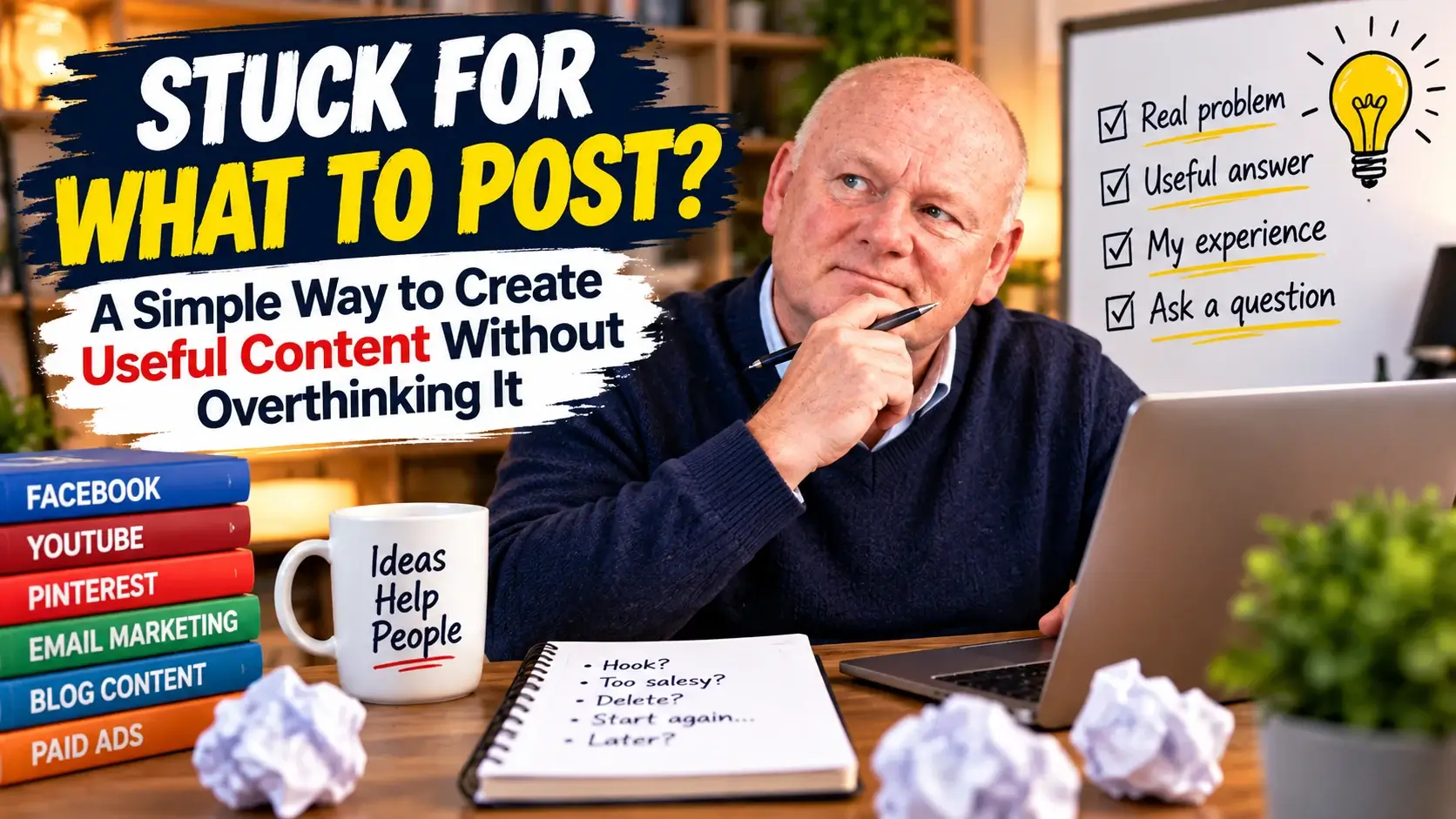
  • Stuck for What to Post? A Simple Way to Create Useful Content Without Overthinking I

    Stuck for What to Post? A Simple Way to Create Useful Content Without Overthinking I

    Stuck For What to Post

    One of the strange things about building an online business is that creating content sounds easy until you actually sit down to do it.

    You know you should probably be posting more.

    More useful Facebook posts. More emails. More blog content. More videos. More conversations with the people you are trying to reach.

    Then you open a blank page and everything suddenly becomes harder. (more…)

  • Another Month Gone. Still Feeling Stuck? How to Make Real Progress Online

    Another Month Gone. Still Feeling Stuck? How to Make Real Progress Online

     Online Business Progress: Stop Feeling Stuck

    The laptop closes. Another evening has gone.

    You have watched the training, adjusted the page, checked the numbers and written half a post. Tomorrow, you will do some version of it again.

    But tonight there is a question you cannot quite shake:

    “What if I keep doing this for another six months—and nothing changes?”

    That is the uncomfortable side of trying to build an online business. You can be working hard, spending money and staying busy without knowing whether the effort is taking you anywhere.

    If you are starting out, or trying again after something did not work, you deserve more than “just keep going”. You need a way to see what is improving, what needs changing and what no longer deserves your time.

    (more…)

  • Chatbots for Beginners: What They Do and How to Get Started

    Chatbots for Beginners: What They Do and How to Get Started

    Have you ever visited a website, asked a simple question and received an instant answer? There’s a good chance a chatbot helped.

    Chatbots can answer common questions, point people toward useful information and help businesses respond when a person isn’t immediately available. They can be useful, but they work best when they have a clear, limited job and an easy way to pass a conversation to a real person.

    If you’re new to the subject, this guide explains chatbots in plain language and shows you how to think through a sensible first use. I’ve also put together a free Chatbot Marketing Starter Guide with a sample conversation flow, a trust checklist and a simple seven day plan. (more…)

  • How to Analyse Paid Traffic: Metrics That Guide Your Next Move

    How to Analyse Paid Traffic: Metrics That Guide Your Next Move

    How to Analyse Paid Traffic Metrics

    A paid traffic report can show impressions, clicks, costs, page visits, leads and sales. The challenge is knowing which number to look at and what it can and cannot tell you.

    Start with the journey, not a single headline metric. A click through rate may help you assess the advert, while a landing page sign up rate can help you inspect the page. Neither one alone tells you whether the whole affiliate campaign is sustainable.

    (more…)

  • How to Start Testing Paid Ads on a Small Budget

    How to Start Testing Paid Ads on a Small Budget

    Small Budget Ad Testing: A Beginner’s Guide

    Paid advertising can bring visitors to an affiliate marketing system more quickly, but spending more does not automatically produce better information or sales. A small, structured test can help you learn how your advert, landing page and follow up work together, provided you set a clear limit and know what you are measuring.

    You may hear advice to start with five dollars a day. Treat that as an example, not a universal rule. The right test budget depends on the platform, audience, costs and how much you can afford to lose while learning. A small budget may generate too few visits to support a confident conclusion.

    (more…)

  • How to Measure a Mobile Affiliate Campaign Before You Scale It

    How to Measure a Mobile Affiliate Campaign Before You Scale It

    Clicks tell you that someone tapped an advert. They do not tell you whether the visitor was a good fit, whether the page worked or whether the offer produced a confirmed commission. To make a sound decision about a mobile affiliate campaign, measure the steps between the ad and the outcome you care about.

    This guide helps you build a basic measurement plan, interpret common gaps and decide what to test next. It is not a promise that a particular metric or campaign will produce a profit. Your results depend on your audience, offer, costs, tracking and the quality of each step in the journey.

    Map the journey before choosing metrics

    Draw the path a person takes after seeing your ad. A simple funnel could be:

    1. Ad impression
    2. Ad click
    3. Landing-page visit
    4. Email signup or other useful action
    5. Click to the affiliate offer
    6. Sale, then confirmed commission

    For each stage, write down what system records it and whether the data is reliable. An advertising dashboard, website analytics, email service and affiliate network may each report a different part of the journey. Sales may appear later than clicks, and some conversions may not be attributed to the advert. Note these gaps instead of treating any one dashboard as the complete truth.

    Choose measures that answer your campaign question

    • Click-through rate: are people responding to the advert in its placement?
    • Landing-page visit rate: do ad clicks result in recorded page visits?
    • Signup rate: are visitors taking the page’s primary action?
    • Cost per signup: how much advertising spend is associated with each recorded signup?
    • Offer click rate: are readers choosing to learn more about the recommendation?
    • Cost per confirmed commission: how much spend was associated with a final commission?

    Use the metric that fits the objective, and keep the next stage in view. A signup may be the immediate goal of a list-building campaign, but the quality of the follow-up and later reader actions also matter. For a sale campaign, distinguish a pending conversion from a confirmed commission.

    Understand the arithmetic, and its limits

    A rough break-even estimate can help set expectations. Suppose a product pays a £40 commission and 2% of eligible visitors eventually generate a confirmed commission. The average commission value per eligible visitor would be 80p before refunds, fees, tracking gaps and other costs (£40 × 0.02 = £0.80).

    That figure is only an illustration based on the assumptions above. It is not a forecast, a target bid or a promise of return. Your actual conversion rate may be different, and the commission may be reversed or delayed. If visitors first join an email list, estimate the later conversion from subscribers and include the cost of follow-up as well.

    Diagnose where people stop

    What you observe What to investigate
    Impressions but few clicks Audience relevance, placement, opening message and whether the creative is clear.
    Clicks but few recorded visits Broken or slow links, redirects, page loading and analytics setup.
    Visits but few signups Message match, usefulness of the resource, form friction and mobile usability.
    Signups but little offer engagement Whether follow-up is relevant, expected and useful to those subscribers.
    Offer clicks but few confirmed commissions Offer fit, sales-page experience, attribution window, reporting delay and audience expectations.

    These are investigation prompts, not diagnoses. Check the relevant page and tracking before deciding what a metric means. A small number of events can fluctuate widely, so avoid treating an early pattern as proof.

    Run a controlled test and keep a log

    Write a question before changing the campaign. For example: “Will a more specific description of the checklist increase relevant signups?” Record the audience, creative, destination page, dates, spend and result. Change one important element at a time where possible. If you change several things together, it becomes harder to learn which change affected the outcome.

    Set a maximum test budget and review date before launch. Do not raise the budget simply to recover a loss. If the test has not collected enough meaningful information, mark it inconclusive rather than declaring a winner. Then decide whether another test is affordable and likely to answer a useful question.

    Make sure the tracking respects people and rules

    Use tracking only as needed to understand the campaign, follow applicable privacy requirements and your site’s consent choices, and avoid collecting information you do not need. Check the current terms for your ad platform, analytics tools and affiliate programme. Keep disclosures clear wherever you recommend affiliate products.

    Decide whether to continue, change or stop

    At the review point, compare the result with the goal you set. If the evidence points to a specific weak step, make one relevant improvement and test again within your limit. If the data is incomplete, the offer is a poor fit or the cost is beyond what you can accept, pause and reassess. Scaling is a decision supported by evidence and budget—not a way to force a campaign to work.

    Measurement makes more sense when you know the full funnel. Start with the mobile advertising framework for affiliate marketers, choose a channel with the platform decision guide, and check the ad-to-landing-page hand-off before you spend.

    For broader business planning, see the Business Essentials Guide.