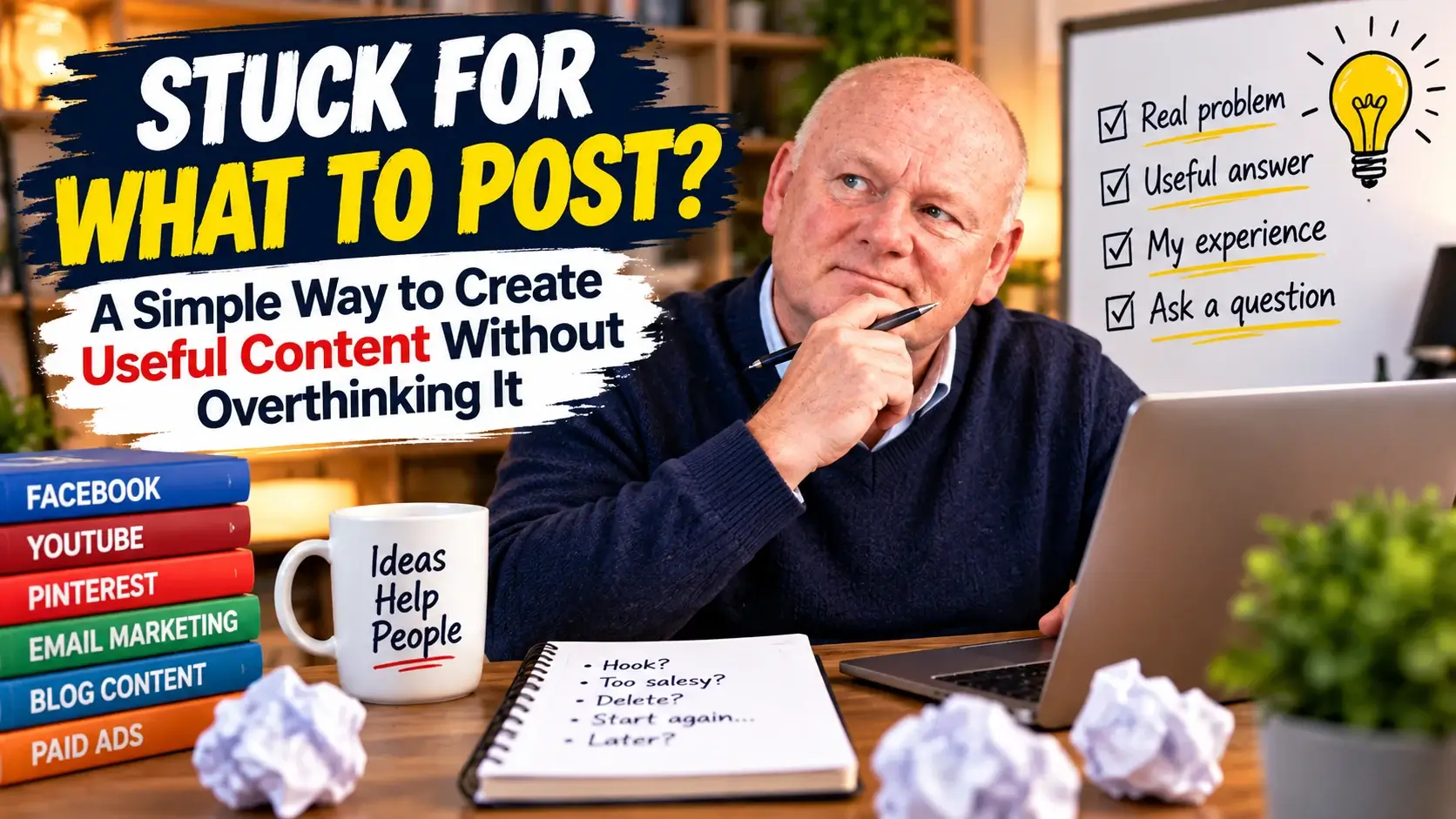
Stuck For What to Post
One of the strange things about building an online business is that creating content sounds easy until you actually sit down to do it.
You know you should probably be posting more.
More useful Facebook posts. More emails. More blog content. More videos. More conversations with the people you are trying to reach.
Then you open a blank page and everything suddenly becomes harder.
What should I write about?
How do I make the opening interesting?
Will anyone care?
Does this sound too promotional?
Do I actually sound as though I know what I’m talking about?
What should have been a quick post turns into 30 minutes of rewriting, deleting and second-guessing yourself.
Eventually you decide you’ll come back to it later.
And sometimes later becomes tomorrow.
Tomorrow becomes next week.
And nothing gets published.
The Problem Usually Isn’t Lack of Effort
Most people who struggle with content aren’t lazy.
They’re often trying too hard to create something clever.
They think every post needs a brilliant hook, a completely original idea and a perfectly polished conclusion.
It doesn’t.
Your audience probably isn’t waiting for literary genius.
They’re looking for something that helps them understand a problem, avoid a mistake or make a better decision.
Helpful beats clever.
Start With a Real Problem
If you’re staring at a blank screen, stop asking:
“What can I post today?”
Ask this instead:
“What is somebody in my audience struggling with?”
That immediately gives you somewhere to start.
For example:
- They’re getting clicks but no sales.
- They’re confused about where to get traffic.
- They’re paying for too many tools.
- They don’t know what to email their list.
- They’re struggling to choose an affiliate offer.
- They keep starting new projects without finishing the old ones.
- They don’t know what to post on social media.
Those are all content ideas because they are real problems.
Give One Useful Answer
You don’t need to solve the person’s entire business in one Facebook post or email.
Give them one useful idea they can understand and use.
Someone says:
“I’m getting visitors but no sales.”
You could explain that before buying even more traffic, they should check whether the people arriving are actually a good match for the offer.
Someone says:
“I don’t know where to get traffic.”
You could suggest choosing one main traffic source and learning it properly before trying five different methods at once.
That’s useful content.
No complicated formula required.
Use Things You’ve Had to Figure Out Yourself
Some of the easiest content ideas come from your own everyday experience.
Think about something that confused you.
Something you got wrong.
Something that took far longer than expected.
Something you’ve recently learned how to do.
If it confused you, there’s a reasonable chance somebody else is confused by it too.
You don’t have to pretend you knew the answer all along.
In fact, saying:
“This caught me out as well. Here’s what I eventually discovered…”
can often feel much more believable than trying to sound like an expert who has never made a mistake.
A Simple Four-Part Content Formula
When you’re stuck, try this:
1. Start with the problem
Describe something the reader will recognise.
Example: “Getting clicks but no sales can be more frustrating than getting no traffic at all.”
2. Give one useful answer
Help them make a sensible next move.
Example: “Before buying more traffic, check whether the visitor, message and offer actually match.”
3. Add something personal
Share a short observation or lesson from your own experience.
Example: “I’ve blamed the traffic before when the real problem was further down the funnel.”
4. End with a simple question
Give people an easy way to join the conversation.
Example: “Which frustrates you more: hardly any traffic, or plenty of clicks with no sales?”
That’s a complete post.
You Don’t Need a Completely New Idea Every Day
This is another trap.
People assume that because they’ve mentioned traffic once, they can’t talk about it again.
But one subject can produce dozens of useful pieces of content.
Take email marketing.
You could talk about:
- Why people stop opening emails.
- How often to email.
- What to send when you have nothing to sell.
- Why constant promotions can cause unsubscribes.
- Subject lines.
- Welcome emails.
- Deliverability.
- Writing in a more natural voice.
- What you’ve learned from your own list.
One subject. Lots of angles.
Questions Are Everywhere
If you genuinely don’t know what to write, look at the questions people are already asking.
Check:
- Comments on your posts.
- Facebook groups.
- Reddit discussions.
- YouTube comments.
- Emails from subscribers.
- Questions from friends or customers.
- Problems you’ve searched for yourself.
A real question is often a better starting point than trying to invent a clever content idea from nothing.
Don’t Turn Every Post Into a Sales Pitch
If every piece of content immediately leads to an offer, people soon notice.
Sometimes just help.
Share a lesson.
Explain a mistake.
Answer a question.
Show somebody a quicker way of doing something.
Those posts still have value for your business because they help people understand what you know and what you stand for.
Trust tends to build gradually.
Publishing Something Useful Beats Publishing Nothing
There will always be another sentence you could improve.
Another headline you could test.
Another paragraph you could rewrite.
But at some point, content has to leave the draft folder.
You learn far more from publishing, watching what happens and improving the next post than you do from endlessly polishing something nobody has seen.
Your goal isn’t to create the cleverest content on the internet.
Your goal is to create something useful enough that the right person stops for a moment and thinks:
“That helped.”
The Next Time You’re Staring at a Blank Screen
Don’t ask yourself what brilliant content you should create.
Ask:
- What problem have I seen recently?
- What question has somebody asked?
- What have I learned?
- What mistake could I help somebody avoid?
- What’s one useful answer I can give?
Pick one.
Write the helpful answer.
Add a little of your own experience.
Ask a question.
Then publish it.
Problem. Help. Experience. Question.
That’s often more than enough.
Building or restarting an online business? My Business Essentials Guide explains the basic pieces an online business needs and why they matter, without burying you in unnecessary jargon.