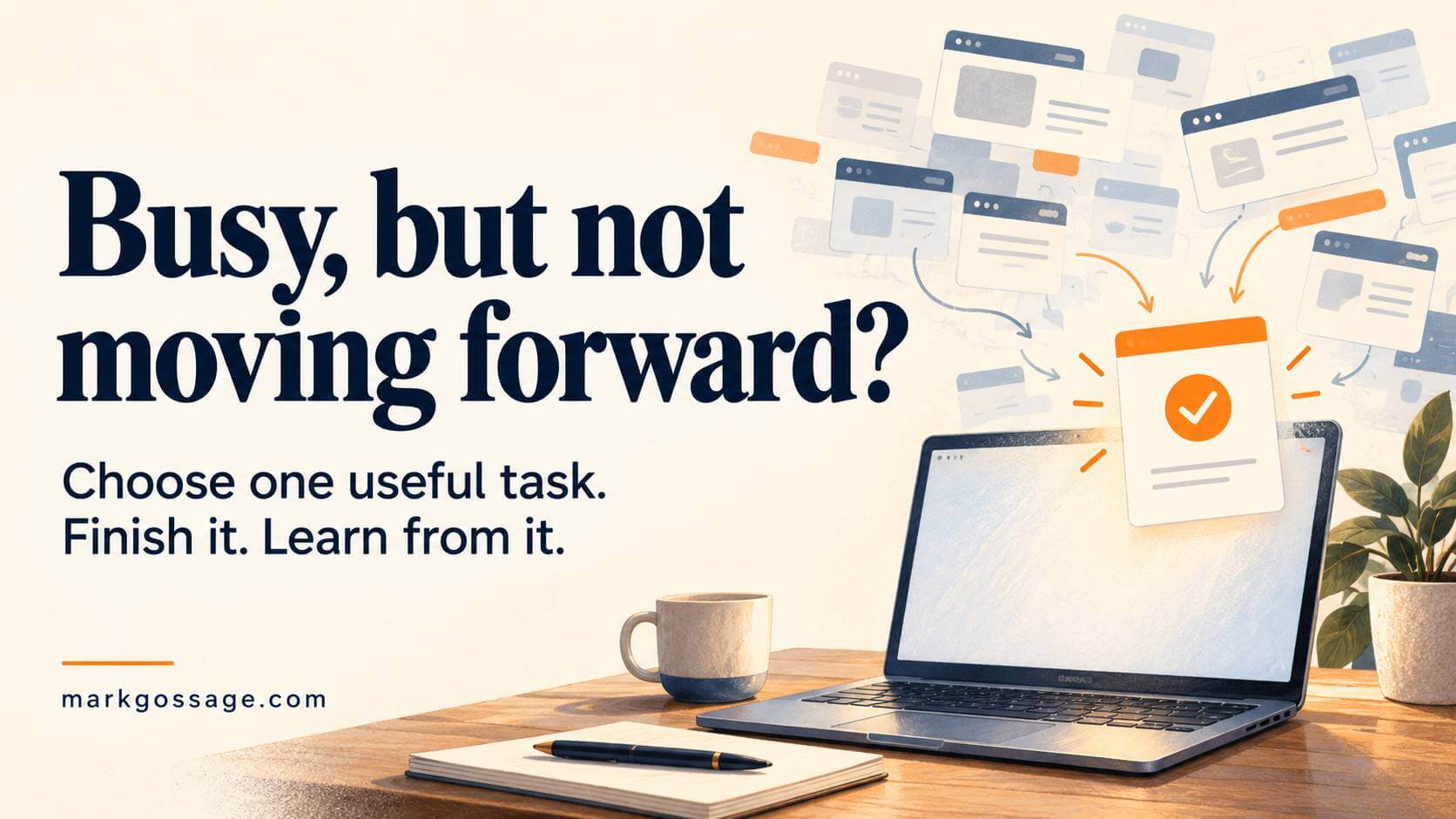
You sit down to work on your online business, open your laptop and start looking for an answer.
An hour later, you’ve watched two videos, compared three tools and found another strategy you might try.
You’ve learned something. But the page you meant to finish is still unfinished, and you’re no clearer about what to do tomorrow.
That can be frustrating, especially when you’re putting in the effort.
Sometimes the problem is that too many decisions are competing for your attention. You need a way to choose the next useful task—and finish enough of it to learn what happens.
Here’s a practical way to begin.
Decide what progress would actually look like
“Work on my business” sounds reasonable, but it leaves a lot of room for wandering.
Give yourself a more definite outcome:
- Publish a page that explains your service.
- Test your signup form and welcome email.
- Write a helpful article answering one customer question.
- Make it clear how someone can request a quote.
- Check that a buyer can access what you’ve promised.
Each task produces something you can inspect or use.
Choose an outcome that matters at your current stage. If people cannot understand what you offer, polishing your logo probably isn’t the most useful place to spend the afternoon.
Ask yourself:
What could I finish that would make the next step easier for a potential customer?
That question helps connect your work to the people your business exists to serve.
Find the part that needs attention first
An online business has several jobs to handle. People need to discover it, understand the offer, contact you or buy, and receive what they were promised.
When something feels stuck, look at those jobs separately.
Perhaps you have a website, but visitors cannot tell who your service is for. Perhaps you have useful articles, but no clear invitation to take the next step. Or perhaps your signup form works, but the guide delivery email contains a broken link.
These are different problems. Buying the same new marketing tool won’t necessarily solve all three.
Walk through your business as a newcomer would:
- Can I understand what this business helps me do?
- Can I find the information I need to decide?
- Is the next step obvious?
- Does that next step work?
- Do I receive what was promised?
Fix the clearest obstacle before adding another layer.
Learn enough to complete the task in front of you
You don’t need to master every part of online marketing before publishing a useful page.
You do need enough knowledge to do the current job properly.
Suppose you’re setting up an email signup form. Your immediate questions might be:
- What am I inviting people to receive?
- Does the form explain that clearly?
- Does the confirmation process work?
- Does the promised resource arrive?
Find the guidance you need for those questions, then apply it.
Save unrelated lessons for later. A detailed course on video production may be useful eventually, but it won’t help you repair today’s signup form.
Keep a small “learn later” list. That gives interesting ideas somewhere to go without allowing them to take over your working session.
Give your work a finish line
Some tasks can absorb as much time as you give them.
A blog post can always have another paragraph. A landing page can always have another design adjustment.
Before starting, decide what “ready” means.
For a beginner’s service page, that might mean:
- It explains who the service is for.
- It describes what is included.
- It gives a clear way to enquire.
- It works on a phone.
- Its claims are accurate.
Once those requirements are met, you have something useful to publish and improve.
Check the important details carefully, especially prices, promises and anything involving customer information. For smaller cosmetic choices, set a limit so they don’t prevent you from finishing.
Choose tools by the job they need to do
Before paying for software, complete this sentence:
“I need this tool to help me ______.”
Be specific.
“Send the promised guide to confirmed subscribers” gives you a job to assess. “Grow my business” is too broad to tell you whether a subscription is worthwhile.
Then check whether something you already have can do it.
Templates and ready-made resources can save setup time, but they still need checking and adapting to your audience, offer and responsibilities.
Understanding the job first makes it easier to judge whether the tool belongs in your business now—or can wait.
Review what happened before changing direction
Completing a task gives you something to learn from.
A published page lets you ask whether readers understand the offer. A tested signup process shows whether someone can receive your emails. A helpful article gives you something relevant to share.
Keep a brief record:
- What did I complete?
- What did I observe?
- What is still unclear?
- What should I change next?
Separate a working process from a successful marketing result. A form working correctly is useful progress, but it doesn’t tell you whether your offer will attract subscribers.
When results are limited, look for the missing information. You may need clearer wording, more suitable visitors or feedback from someone in your intended audience.
Try to change one meaningful thing at a time so you can understand what helped.
Start with a clearer picture of your business
If you’re unsure which task deserves your attention, my free Business Essentials Guide is a useful starting point.
It explains the eight essential jobs every business needs to handle, with practical examples for a local service, an online shop, and a consultant or creator.
You’ll also find:
- Plain-English explanations of websites, domains, hosting, email, payments and records.
- A checklist to use before paying for a tool.
- A practical four-week starting plan.
- A one-page worksheet for your own business.
The aim is to help you separate what you need now from what can wait.
Get your free Business Essentials Guide and join my free Business Notes
Enter your email on the page and confirm it. I’ll send you the guide first, followed by my free Business Notes emails exploring individual tools and business decisions in more depth.
Some emails may include optional paid tools or affiliate recommendations that earn me a commission if you buy. There’s no requirement to purchase anything, and you can unsubscribe at any time.
Start with the guide, choose one useful task, and give yourself a clear place to begin.