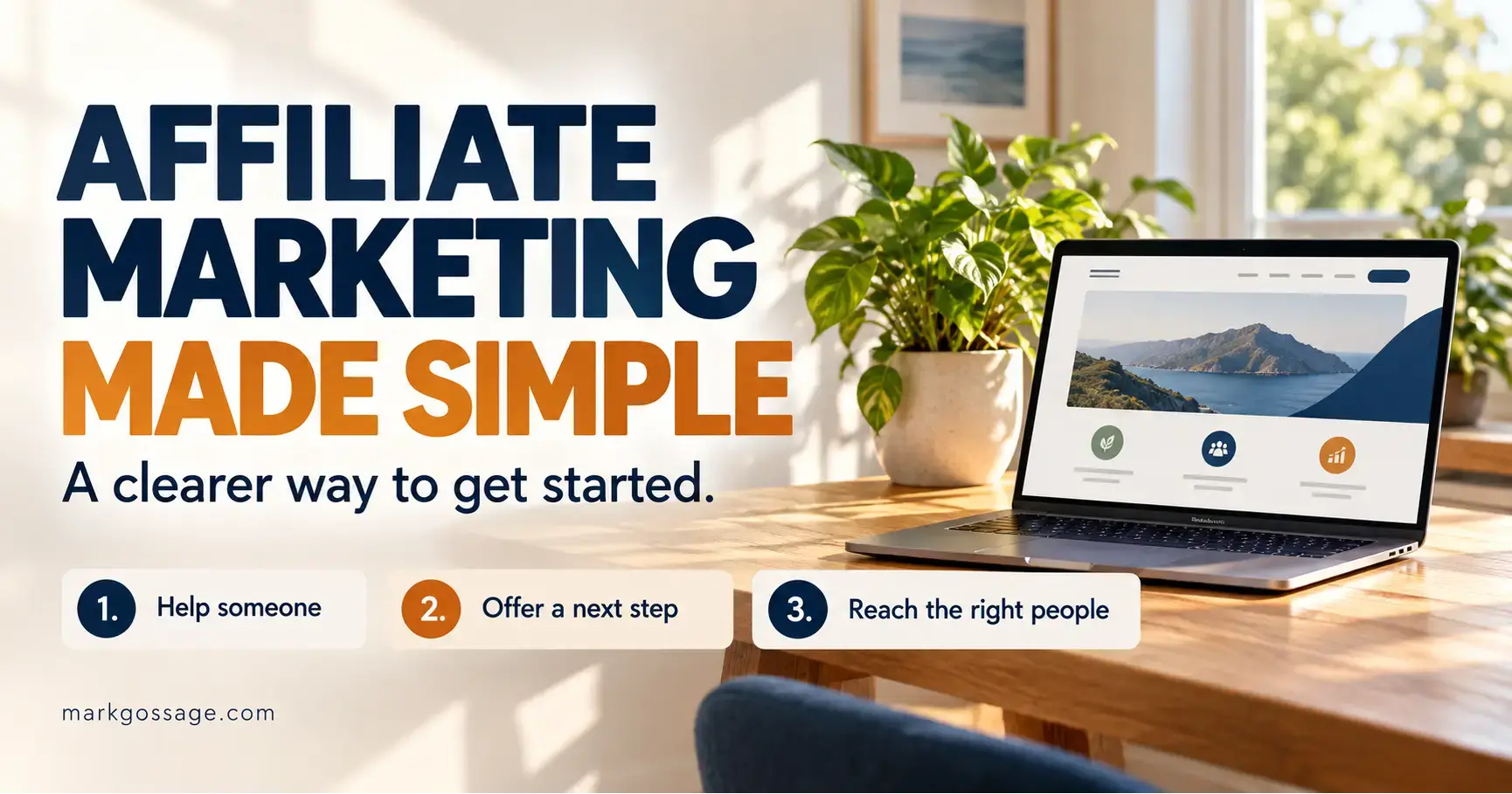
Affiliate marketing for beginners: what does it actually mean?
Trying to understand affiliate marketing can leave you with more questions than answers. One person says you need a blog. Someone else says you need paid adverts. Then along comes another tool promising to do everything for you.
If you are new to this, or giving it another go after a disappointing start, it can feel as though everyone else knows something you do not.
Let’s slow it down. You need a useful recommendation, a clear way to help people, and a way for the right people to find you. Understanding how those pieces fit together gives you somewhere sensible to start.
First, what does affiliate marketing actually mean?
Affiliate marketing means recommending another business’s product or service. When someone buys through your special tracking link, you may earn a commission under that business’s affiliate programme.
You might explain how a website hosting service works, compare email marketing tools, or show someone how to use a product. Your content helps them decide whether it suits their needs.
The recommendation should still be useful even if the reader decides not to buy. That is the standard I want my content to meet.
You do not have to create the product yourself, but you are responsible for the care you put into recommending it. That means explaining its limitations as well as its strengths, and making your affiliate relationship clear.
Step 1: Start with a person and a problem
Before looking at commission rates, think about who you want to help.
“Anyone who wants to make money online” is a very broad audience. “A beginner trying to set up their first business website without buying unnecessary tools” gives you something much clearer to work with.
You can picture their questions:
- What do I actually need to get started?
- Which tools can wait until later?
- What will this cost after the introductory offer ends?
- Will I be able to get help if something goes wrong?
Those questions are useful starting points for both your content and your product research.
Choose something you can explain honestly
A large commission can look tempting. But if the product is unsuitable for your readers, the payout does not make it a good recommendation.
Before promoting something, ask:
- Does it solve the problem? Look beyond the sales headline to what the customer actually gets.
- Who is it suitable for? A powerful tool may still be too expensive or complicated for a beginner.
- What are the ongoing costs? Check renewal prices, necessary extras and any usage limits.
- What support is available? Find out where customers go when they need help.
- What can I verify? Separate your own experience from the company’s claims.
- How does the affiliate programme work? Read its payment conditions and promotion rules.
If you have used the product, explain what you actually did with it. If you have only researched it, say that. You can write a helpful comparison without pretending to have tested everything yourself.
Recurring commissions can be worth considering, but they depend on the programme’s terms and the customer continuing to qualify. They are a possible benefit, not a reason to recommend the wrong service.
A useful test: would you still feel comfortable suggesting this product if it paid a smaller commission?
Step 2: Give people a clear, helpful next step
Once you know who you are helping and what you might recommend, make the journey easy to follow.
A beginner reading about their first website might need a simple checklist before they are ready to choose hosting. Someone comparing email services might need an explanation of the features they will actually use.
You can provide that help through a blog post, a tutorial, a useful download or a short email series.
A simple email journey
One approach is to offer a helpful guide on a page where visitors can choose to subscribe. You then deliver the guide and send useful follow-up emails with their permission.
The journey might look like this:
- A reader finds your article about starting a business website.
- They choose to request a guide that explains the basics.
- They follow the sign-up instructions and receive the guide.
- Your follow-up emails help them understand their next steps.
- You introduce a relevant product when it fits what they need.
That gives you time to explain things properly. It also gives the reader time to decide.
An email list is one useful approach. A thorough review or tutorial can also lead directly to a relevant product. The important part is that the next step makes sense for the reader.
Keep your sign-up page straightforward
Before someone enters their details, they should understand:
- What they will receive.
- Who it is intended to help.
- What emails they are agreeing to receive.
- What happens after they sign up.
Use everyday language and one clear main action. If you use a confirmation email, explain that they need to check their inbox and confirm their request.
Then test the whole process yourself. Open the page on your phone, submit the form, check the emails and follow the download link. A working journey matters more than a fancy page.
Need help putting the basics in order?
If you are still wondering what you need and what can wait, my Business Essentials Guide is a practical starting point. It explains what an online business needs and why, so you can make more informed decisions about your next steps.
Request my free Business Essentials Guide here.
You do not need to figure everything out in one sitting. Start with the foundations and build from there.
Make your emails worth opening
Think of your follow-up emails as a continuation of the help you have already offered.
One email could explain a common mistake. Another could walk through a small task. A later email could discuss a suitable tool, including its costs and who may not need it.
Keep each message focused. Give readers something they can understand or use, and make it easy to unsubscribe.
When you include an affiliate recommendation, clearly explain that you may receive a commission if they buy through your link. People should understand the relationship before deciding.
Step 3: Help the right people find you
“Traffic” simply means visitors. But the number of visitors only tells you part of the story.
A person looking for help with their first website is more likely to find a beginner’s website guide relevant than someone who arrived expecting a completely different topic.
Your content, your offer and your next step should all answer the same need.
Choose one main place to start
You could attract readers through helpful blog posts, YouTube tutorials, Pinterest content or useful contributions to relevant communities.
Choose a channel you can work on regularly. Give yourself time to learn what people respond to before adding several more.
For example, you could write a clear article answering one beginner question, then create a short video explaining one part of it. That is a manageable way to reuse your work without trying to produce everything at once.
Free traffic still takes time and effort. Paid adverts cost money and need careful testing. Neither guarantees sales.
If you try adverts, check that the platform and affiliate programme allow your approach, set a budget you can afford to lose, and confirm that the page and tracking work before spending more.
Getting clicks? Check what happens next
Clicks can be encouraging, but they do not tell you whether the rest of the journey is working.
Look at where people stop:
- People see your content but rarely click: check whether the topic and next step are relevant to them.
- People visit but rarely subscribe: check whether the guide’s benefit is clear and the form works on mobile.
- People subscribe but do not receive the guide: check confirmation instructions, email delivery and the download link.
- People read your emails but rarely follow recommendations: consider whether the product fits their needs and whether you have explained it clearly.
- People click the product link but do not buy: there may be concerns about price, suitability or the seller’s page. Check the link and tracking too.
These are starting points for investigation, not proof of what went wrong. A handful of visits is usually too little information to judge an entire approach.
Change one important thing at a time, keep a note of what you changed, and compare what happens afterwards.
For paid traffic, also compare your advertising costs with the commission you actually receive. Sales can feel like progress while still leaving you out of pocket.
A small plan you can actually finish
If all this still feels like a lot, bring it back to one manageable project:
- Choose one beginner problem. Write it in a single sentence.
- Research one suitable product. Note its benefits, limitations, costs and affiliate terms.
- Create one helpful piece of content. Answer the question before asking the reader to do anything else.
- Add one relevant next step. That could be a guide, another useful article or a clearly explained recommendation.
- Test the journey. Check the page, form, emails and links.
- Share it through one main channel. Review the response before building something bigger.
Your first aim is to create something useful and get the basic journey working. It is much easier to improve a small finished project than a collection of half-built ideas.
You can start small and still take it seriously
Affiliate marketing involves learning, testing and ongoing work. It does not require you to buy every tool or understand every strategy before you begin.
Start with someone you can help. Make a recommendation you can stand behind. Give them a clear next step, then learn from how they respond.
If you would like a little help with the foundations, request my free Business Essentials Guide. It is there to help you understand what you need and why, so your next decision feels a little less overwhelming.
One useful step at a time is a perfectly sensible way to build.