You start with a sensible idea: recommend something useful and earn a commission when someone buys.
Then come the decisions. Which products? Which website software? Should you write articles, make videos or pay for advertising? Do you need an email list straight away?
Before long, a business you hoped would be manageable has turned into a collection of unfinished tasks.
If that sounds familiar, let’s give you a clearer place to begin. Whether you’re new to affiliate marketing or trying again after an earlier attempt, you can build a plan around your actual time, budget and abilities.
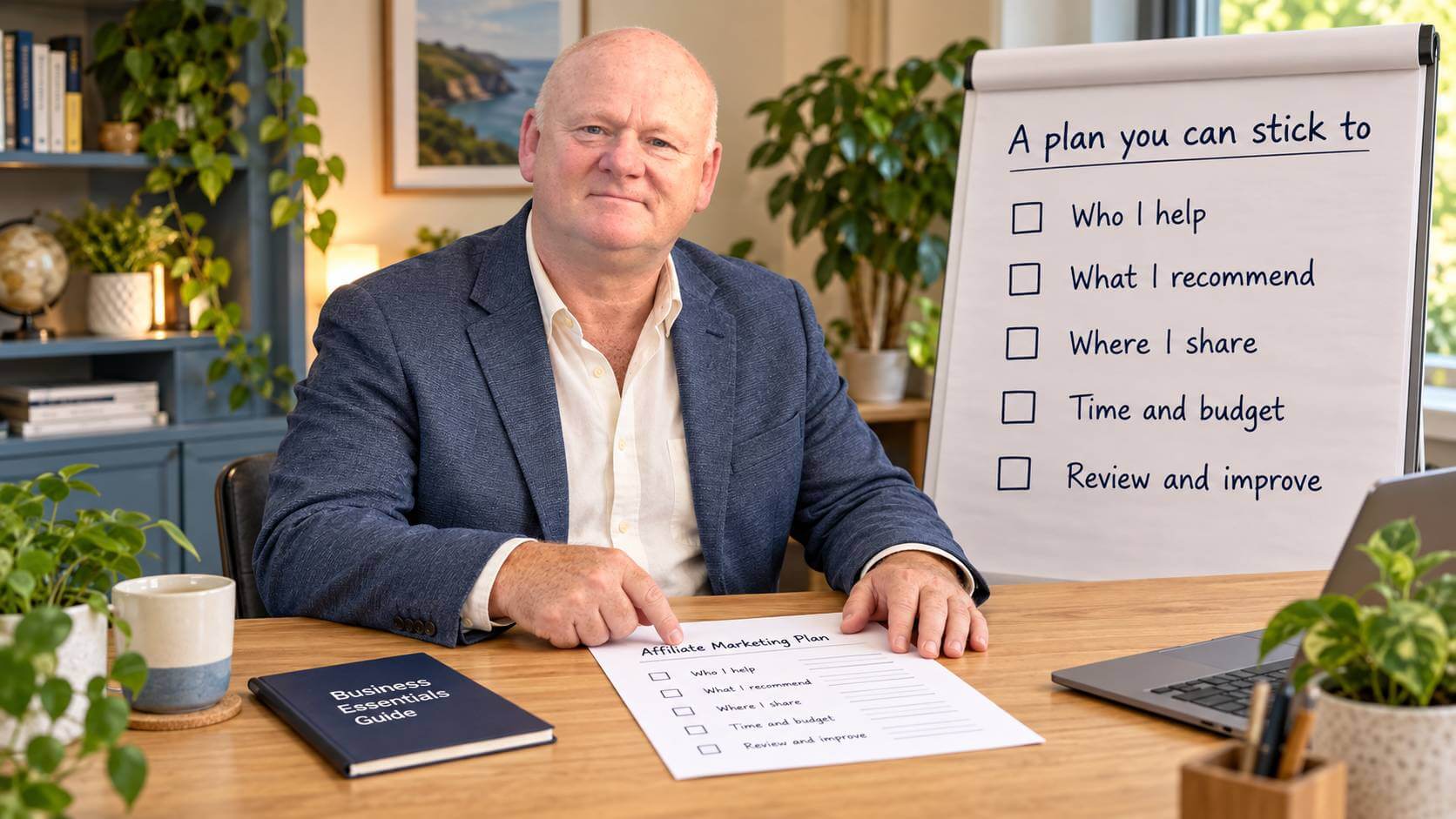
An affiliate marketing plan is simply a written explanation of who you’ll help, what you’ll recommend, how people will find your advice and how you’ll judge your progress. It doesn’t need to be a complicated document.
It needs to help you decide what to work on next.
1. Set goals you can turn into weekly actions
It’s reasonable to want extra income or a business you can grow. But an income target on its own doesn’t tell you what to do on Tuesday afternoon.
Start by writing down how much time you can give the business each week and what you can afford to spend. Include the recurring costs, not just the attractive introductory prices.
Then choose a few actions you can control. For example, you might plan to publish one useful article a week, check one product carefully and improve your guide signup page.
Keep your income ambition, but treat it as an aim rather than a forecast. Commissions depend on demand, the offer, your audience and other factors. There’s no fixed timetable for earning them.
A useful first goal: “Over the next month, I’ll choose one audience, assess one relevant product and publish two pieces of helpful content.”
2. Choose people you can genuinely help
A niche is the particular audience or subject your business focuses on. You don’t have to make the word more complicated than that.
“Business software” is a broad subject. “Helping sole traders choose the tools for their first website and newsletter” gives you a clearer group of people and a clearer set of questions to answer.
Look for problems you understand, an audience you can reach and products that could reasonably help. Read people’s questions, listen to their frustrations and notice what they’re trying to achieve.
- What are they finding difficult?
- What have they already tried?
- What information would help them make a decision?
- Can you provide that information accurately?
You don’t need to pretend to be an expert in everything. Stay within what you can explain responsibly, and be clear when something requires specialist advice.
3. Assess the product before planning the promotion
Affiliate marketing means you may earn a commission when someone makes a qualifying purchase through your tracked link. That financial relationship makes careful recommendations particularly important.
Check the product’s purpose, price, limitations and support. Understand what’s included in the version you’re recommending, whether there are extra costs and what the buyer must do themselves.
Also read the affiliate programme’s terms. Check how qualifying sales are tracked, when commissions are paid and what happens with cancellations or refunds.
If you’ve used the product, describe your real experience. If your assessment is based on documentation or a demonstration, say so. Explain clearly when your recommendation may earn you a commission.
Begin with a small number of relevant offers you can understand properly. Add complementary products as you identify genuine needs. Having more offers doesn’t automatically make your income stable.
4. Pick a main place to publish your advice
You can build useful content through a website, a video channel or another suitable platform. Choose somewhere your intended audience looks for help and a format you can maintain.
If you enjoy explaining things in writing, articles may suit you. If you can demonstrate a task clearly on screen, video may be useful. Start with a manageable approach before expanding.
Make it easy for visitors to understand who you help, what your content covers and how to take the next step. Test the pages and links on your phone as well as your computer.
Templates can save time, but check their wording and settings. A page you can publish quickly still needs to make sense for your audience.
5. Create content that answers a real question
You don’t have to turn every article into a product pitch. Help someone understand the problem first.
For beginners building a business online, useful topics might include what a website needs, when email software becomes helpful or which costs to check before choosing a subscription.
When a product fits the topic, explain how it helps and when it might be the wrong choice. A reader should leave knowing more, even if they don’t click an affiliate link.
Plan around a few questions you can answer well. A simple calendar might contain one main article and a couple of shorter posts explaining parts of it. Choose a frequency that fits your week.
Review older recommendations too. Prices, features and terms can change, and an accurate article needs attention after publication.
6. Give interested readers a reason to stay in touch
Someone can appreciate your advice without being ready to buy. They may still be choosing a business idea or working out their budget.
A useful guide and an email newsletter can help you continue the conversation with people who choose to hear from you.
Explain what they’ll receive before they subscribe. If requesting a guide also means receiving newsletters, make that clear. Deliver the guide as promised and make unsubscribing straightforward.
Your follow-up emails can explain one decision, walk through one task or answer one common question. Keep recommendations relevant and identify your commission relationship where it applies.
Think about the person opening the email. What would make their next step easier?
7. Review progress before spending more
You don’t need a complicated reporting system to begin. You need enough information to see what deserves attention.
- Are suitable people finding your content?
- Which questions or articles attract interest?
- Are readers choosing to subscribe?
- Are recommendations producing qualifying sales?
- What are you spending, and what is left after costs?
Use replies and customer questions alongside your figures. Email opens are only a rough signal; privacy features and automated activity can affect them.
Avoid making a big decision from a tiny amount of data. Look for patterns, investigate likely problems and change one thing at a time. Before adding tracking tools, consider what information you need and the privacy and consent requirements that apply.
Consistency means following a useful routine and learning from it. It also means being willing to stop or change an approach when the evidence and costs suggest you should.
If you’re trying again, make this plan fit you better
An earlier attempt that didn’t work can knock your confidence. It doesn’t mean you have to throw away everything you learnt.
Ask what made the last plan difficult. Too many tools? Too many products? A publishing schedule you couldn’t maintain? Spending before you understood the offer?
Be specific enough to change something. “I tried to run five channels with three hours a week” gives you a useful starting point. This time, you could choose one channel and a smaller routine.
You’re allowed to build at a pace that fits your circumstances. A plan you can carry out and review is more useful than one that looks impressive on paper.
Write your first affiliate marketing plan on one page
Before opening another comparison tab, complete these six sentences:
- The people I want to help are…
- The problem I’ll focus on first is…
- The product I’ll assess, and why, is…
- The place I’ll publish useful advice is…
- The time and money I can commit are…
- The date I’ll review my progress is…
It’s fine to leave a question unanswered while you investigate it. That’s more helpful than filling the gap with a guess and buying software to match.
Get your free Business Essentials Guide and work out what you need
If you’re thinking, “This makes sense, but I still don’t know which tools belong in my business,” let me help you work through that.
My free Business Essentials Guide explains the core jobs a business needs to handle, why they matter and how to think about the tools that support them. It’s written in everyday language for beginners, small business owners and people starting again.
Use it alongside your plan to ask better questions: What is this tool for? Do I need it now? What can wait until the business has grown?
Request the guide on the page below and confirm your email address. You’ll receive the guide to read and download, followed by my free Business Notes newsletters. We’ll go deeper into practical tasks, individual tools and useful developments, one topic at a time.
There’s no requirement to buy anything, and you can unsubscribe whenever you wish. Some recommendations may earn me a commission, which I’ll disclose.
You don’t need to have it all worked out before you join me. Start with the guide, choose one manageable step and build your understanding from there.
Get my free Business Essentials Guide
Includes Business Notes by email. Confirm your email address to receive your guide.