If you’re trying to start an online business, it can feel as though everyone is handing you another job.
Build a website. Start making videos. Learn advertising. Set up email software. Post every day.
Before long, you’re spending more time deciding what to do than actually doing it.
If you’ve tried before and things didn’t work out, that noise can be even harder to face. You want to make a better decision this time, but you’re not sure which advice to trust.
Let’s slow things down and look at how a business finds customers.
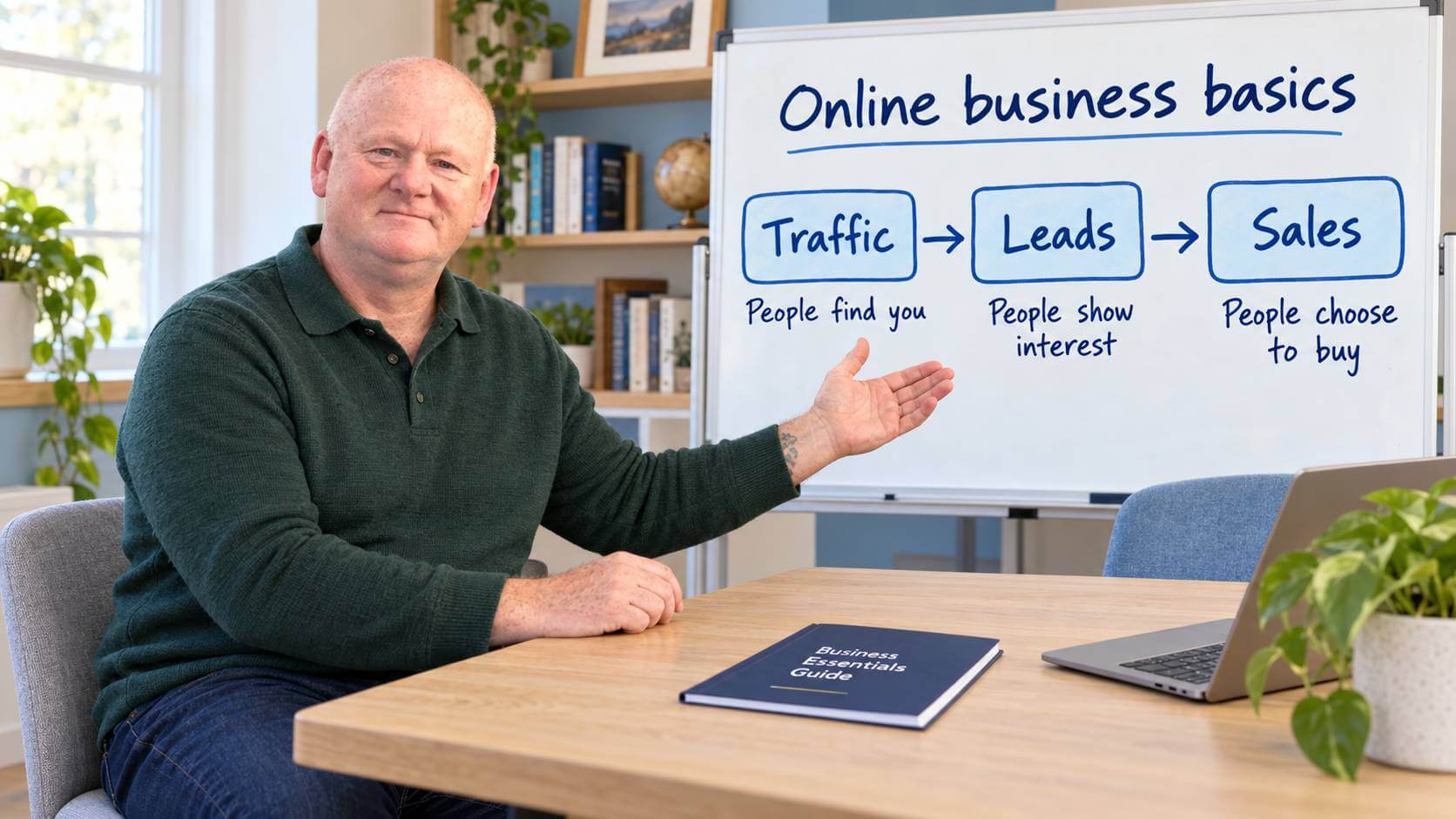
You may have seen this formula:
Traffic → Leads → Sales
In everyday language, that means: people find you, some show interest, and some decide to buy.
It’s a useful way to understand part of an online business. It isn’t a guarantee of success, and it doesn’t cover everything. A business also needs a worthwhile offer, dependable delivery and costs it can manage.
But once you understand these three stages, it becomes easier to see what you’re working on and which tools might actually help.
What does traffic mean in an online business?
Traffic simply means people visiting your website, product page or another place where they can learn about your offer.
Think of it as people coming through a shop door. Getting them inside matters, but it also matters whether they’re looking for what you sell.
A thousand visitors with no interest in your service may be less useful than a small number who have the exact problem you can help solve.
So your first question is: Who do I want to reach, and what would bring them here?
For example, someone starting a bookkeeping service could answer questions about organising business expenses. A person selling handmade gifts could show the occasions their products suit. An affiliate marketer could explain how to choose a tool for a particular job.
People can discover you through search engines, useful articles, videos, social posts, referrals, marketplaces or advertising.
You don’t have to tackle all of them at once. Choose a starting point that suits your audience, skills and available time. Then give yourself a routine you can realistically maintain.
If you use paid advertising, decide what you’re testing and set a spending limit. Paying for visitors won’t fix an unclear offer or a page that doesn’t work.
What is a lead, and why does it matter?
A lead is someone who has shown interest and given you a suitable way to continue the conversation.
That could be a person requesting a quote, booking a consultation or choosing to subscribe to your newsletter. It doesn’t always mean collecting an email address through a free download.
Imagine you offer a gardening service. Someone who asks about a regular maintenance visit is a lead. They’re interested, but they may still have questions about the price, availability or what’s included.
Your next job is to help them understand those details.
For an online audience, a useful guide and a newsletter can provide another way to stay connected. Someone can learn a little now, then receive more help as they consider their next step.
Be clear about what they’re requesting. If a guide comes with an ongoing newsletter subscription, explain that before they submit their details. Make leaving straightforward too.
Permission matters. Someone asking you for a quote hasn’t necessarily agreed to receive every future marketing email.
How an email list can support your business
A person may find your advice useful today without being ready to buy anything.
Perhaps they’re still choosing an idea. Perhaps they need to save money. Perhaps they want to understand the options before committing.
Helpful emails give you a way to continue that conversation with people who have chosen to hear from you.
You might explain a confusing term, walk through a practical task or show when a particular tool is worth considering. Each email should give the reader something useful, even if they never make a purchase.
An email list can reduce your dependence on people remembering to revisit your website. It still needs care: accurate subscriptions, secure handling of information, sensible sending habits and working unsubscribe options.
Those subscribers are people giving you their attention. Treat that attention as something to look after.
What helps turn interest into a sale?
A sale happens when someone decides your offer is worth paying for.
Helpful advice can support that decision, but friendliness alone won’t make an unsuitable product right for someone.
The buyer needs to understand:
- What they’ll receive.
- How it addresses their problem.
- What it costs, including any ongoing charges.
- What they’ll need to do themselves.
- What happens after payment.
For your own service or product, explain the scope and delivery clearly. For an affiliate recommendation, understand the version you’re promoting and make clear when you may earn a commission.
Be honest about limitations. If a tool is too complicated for a beginner, requires an extra subscription or only suits a particular type of business, say so.
People need useful information to make their own decision. Sometimes the right decision will be to buy. Sometimes it will be to wait or choose something else.
A simple example of traffic, leads and sales
Suppose you help small businesses create straightforward websites.
You publish an article explaining what a basic service-business website needs. Someone searching for help finds it. That’s a visitor.
They read your advice and request a consultation. That’s an interested enquiry.
You discuss their needs, explain your service and provide a clear price. If it suits them, they may become a customer.
Then you still need to deliver the website, communicate properly and handle any agreed follow-up work.
The same broad journey can apply to other businesses, but the steps vary. A shopper may buy directly from a product page without subscribing to anything. A local business may receive a phone call rather than an email lead.
Use the formula to understand the customer’s journey. Fit the process to your business.
What is a sales funnel, in plain English?
A sales funnel is a name for the steps that help someone move from discovering you to considering and buying your offer.
It could involve an article, a signup page, helpful emails and a product page. It could also be as simple as a service page followed by an enquiry and a conversation.
Software can make some tasks easier. It can send a requested guide, confirm a subscription or deliver a scheduled email.
But a ready-made funnel still needs an appropriate audience, accurate wording, working links and an offer people want. You’ll also need to check what happens after someone signs up or buys.
Automation saves work when the process is useful. It can repeat a confusing process just as efficiently.
Where to focus when things aren’t working
If you’re starting again, use these stages to ask more specific questions about the previous attempt.
Few suitable people saw the offer: look at how you’re reaching your audience and whether your message matches what they need.
People visited but didn’t enquire: check whether the page explains the offer and gives them a clear, working next step.
People enquired but didn’t buy: consider their questions, the price, the fit and whether they understood what was included.
People bought but were disappointed: review delivery, support and whether your promises matched the experience.
These are starting points for investigation, not automatic diagnoses. A handful of visits or enquiries may not tell you enough to draw a conclusion.
Keep a simple record, ask for feedback where appropriate and change one thing at a time. That gives you a better chance of learning what helped.
Choose tools after you understand the job
You may need somewhere to explain your offer, a way to handle enquiries, a payment method and a system for keeping track of your work.
If you’re building a newsletter, you’ll need a suitable way to manage subscriptions and send emails. If you’re selling physical products, your priorities will also include orders and delivery.
Your setup depends on your business. Buying everything someone recommends can leave you with extra costs and more things to learn.
Before paying for a tool, ask: What job will this do for me now?
If the answer is unclear, take a moment to understand the need before adding another subscription.
Get your free Business Essentials Guide and build from there
If this has helped you see how the pieces connect, your next question may be: “What do I actually need to put in place?”
That’s what my free Business Essentials Guide is designed to help you work through.
It explains the core jobs a business needs to handle, why they matter and how to think about the tools that support them. It’s written in everyday language for people starting out, small business owners moving online and people ready to try again.
You don’t need to arrive with everything worked out. You’re welcome with an idea, a few questions or an earlier attempt you want to learn from.
Request the guide through my homepage and confirm your email address. You’ll receive the guide, followed by my free Business Notes newsletters, where we’ll take individual topics further: practical steps, tool choices, what to consider and useful developments as things change.
The aim is to help you understand your choices and take manageable action. There’s no requirement to buy anything, and you can unsubscribe whenever you wish. Some recommendations may earn me a commission, which I’ll disclose.
Start with the guide, choose one useful job to work on, and let’s build your understanding from there.