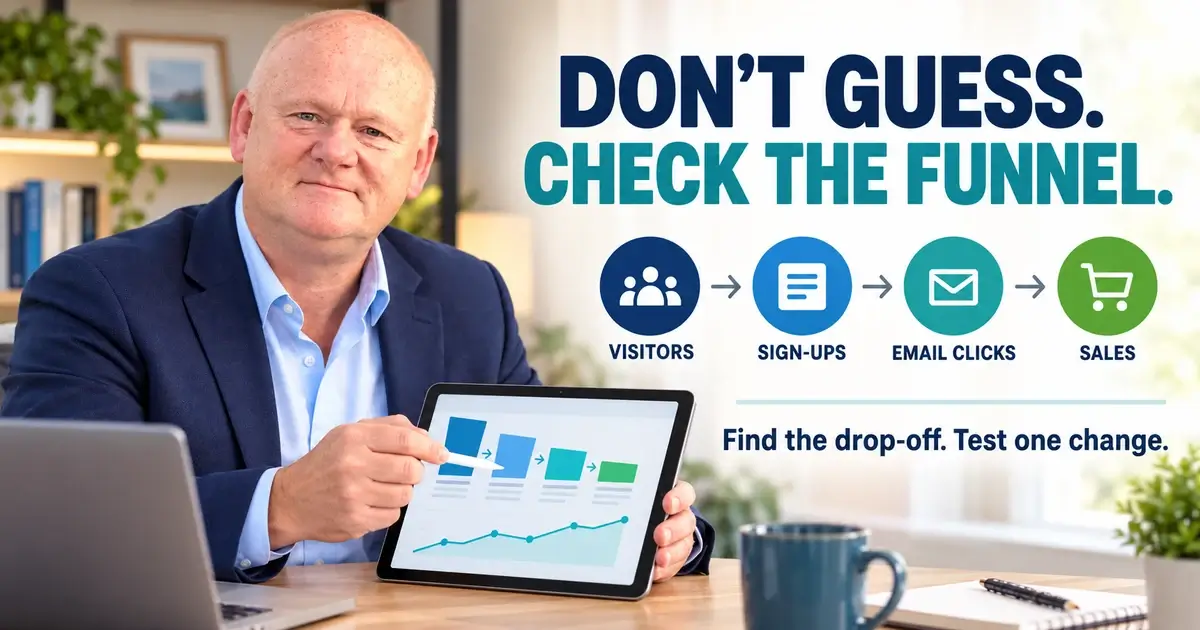
Getting visitors to a page is only the first part of marketing. If people arrive but few take the next step, it is tempting to change everything or assume you simply need more traffic. A better starting point is to map the journey and check what people are doing at each stage.
Funnel metrics can help you identify where to investigate. They do not explain every decision or guarantee that a particular change will improve results, but they give you a more useful starting point than guessing.
What is a marketing funnel?
A marketing funnel is the sequence of steps a person may take as they move from discovering your business to considering an offer and possibly becoming a customer. A simple online funnel might look like this:
- A person sees a post, video or advert.
- They visit a landing page.
- They choose whether to sign up for a guide or other resource.
- They receive follow-up emails.
- They click through to an offer and decide whether to buy.
People can leave at any point, and that is normal. The aim is not to force everyone through the funnel. It is to make each step clear, relevant and easy to use, then learn from the patterns you observe.
Track the steps separately
For a basic funnel, record these numbers for the same date range:
- Visitors: how many people reached your page, and which source brought them there.
- Sign-ups: how many visitors subscribed or completed another page action.
- Email clicks: how many subscribers clicked a link in your follow-up.
- Purchases: how many people bought, if your tracking provides reliable purchase data.
Keep the source and time period attached to the numbers. Someone who joins your email list today might not see an offer or make a decision until later, so comparing unrelated periods can lead to the wrong conclusion.
Understand the conversion rate at each stage
A conversion rate is the percentage of people who take a specified action. For example, if 100 people visit a landing page and 20 subscribe, the visitor-to-subscriber conversion rate for that period is 20%.
Be specific about what you mean by “conversion rate.” A page visit to sign-up rate, an email delivery to click rate and an offer-page visit to purchase rate measure different actions. Name the start and end points so you know what the number describes.
Also be careful with small samples. If only a few people visit, a single sign-up or sale can move the percentage sharply. Treat early figures as clues to investigate, not firm proof of how the funnel will perform over time.
What to check when people drop off
Visitors arrive, but few sign up
Check whether the page matches the message that attracted visitors. Is it immediately clear who the resource is for and what someone will receive? Is the form easy to complete on a phone? Test the form yourself and make sure the promised email or download arrives.
The issue may be the source of the visitors, the page message, the offer or a technical fault. The numbers identify a stage to inspect; they do not tell you which cause is responsible by themselves.
People sign up, but few click your emails
Review whether the follow-up continues the conversation the subscriber expected. Does the email deliver the promised resource? Is the message useful? Is the next step clear, and does the link lead to what the email says it will?
Check delivery and link tracking too. If your email platform reports opens, remember that privacy features and image loading can make open data less dependable than clicks or replies.
People click an offer, but purchases are limited
A click suggests interest in learning more, but it does not guarantee that someone intends to buy. Check whether the offer fits the problem discussed in your content. Review whether the sales page clearly explains the product, price, relevant limitations and who it may suit.
Where possible, check that purchase tracking is working and that the time window accounts for people who need more time to decide. Avoid judging the offer from a handful of clicks alone.
Use the data to choose one improvement
Once you spot a possible drop-off, write down a question you want to test. For instance: “Would visitors understand the guide more quickly if the page headline named the problem it helps with?” Make one focused change and note when you made it.
Give the change a fair opportunity to gather observations, then compare the same metric over a comparable period. If you change the headline, form, email sequence and offer together, it becomes difficult to tell which change mattered.
Before making marketing changes, test the basic mechanics: page loads, links work, forms submit, confirmation messages appear and follow-up emails arrive. A broken step can look like a copywriting or traffic problem.
Traffic is feedback, not a verdict
Traffic brings people into your system and gives you opportunities to observe what happens next. It does not close the sale by itself, and the numbers cannot reveal every reason someone decided to continue or leave.
Track visitors, sign-ups, email clicks and purchases separately. Look for a pattern, investigate the relevant step, and make one measured improvement at a time. That gives you a clearer basis for your next decision than repeatedly rebuilding the entire funnel.